In 2024, Weichert Development Company put forward a plan that would have taken down two Victorian homes at 204 and 210 Main Street to make way for a three-story apartment building. There was no ordinance on the books that could stop it. Moorestown had no local historic preservation law with legal teeth, and residents watching the proposal move forward realized the town had no way to say no to that kind of demolition, no matter how the buildings looked or how long they'd stood there.
That gap is closed now, though this isn't the town's first attempt at closing it. Moorestown adopted a local preservation ordinance back in 2006, only to see it repealed by 2009 after legal challenges from a local attorney unraveled the effort. Nearly two decades passed with no commission and no legal teeth behind any preservation goal, until Township Council adopted Ordinance 06-2025 on April 7, 2025, establishing a new Historic Preservation Commission and a mapped Historic District. If you're shopping for an older home here, you've probably heard about it secondhand, usually as a vague warning that buying "in the historic district" means design review, permit delays, and a commission telling you what you can and can't do to your own house.
Here's what the warning gets wrong: for most buyers looking at character homes in Moorestown, none of that applies. The real story is narrower and more specific than the rumor, and it hinges on two separate lists that have almost nothing to do with each other.
Where the Map Actually Stops
The mapped Historic District that Ordinance 06-2025 created covers, in the words of Julie Maravich, president of Saving Historic Moorestown, a strikingly small footprint.
"This ordinance protects and historically preserves less than 1% percent of the actual area of Moorestown, and while it's less than 1% percent of the entire town, it's arguably the most important 1% of the entire town."
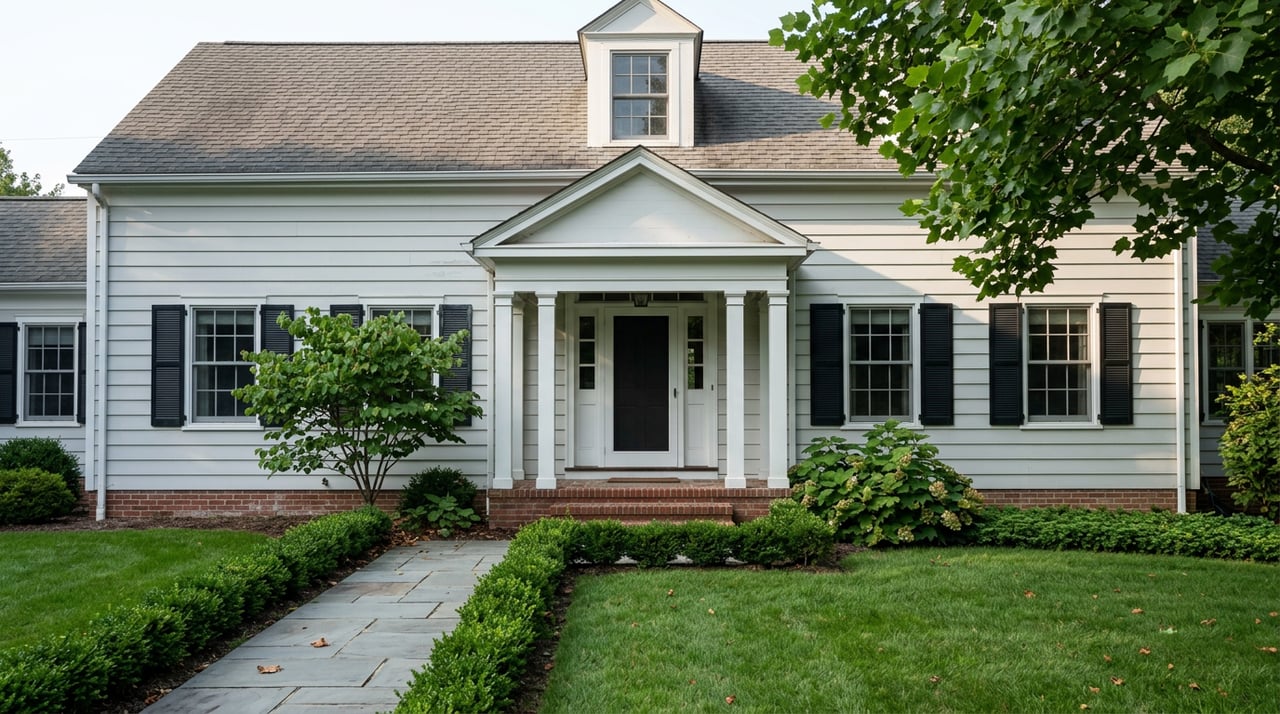
That 1% is concentrated along central Main Street and part of Chester Avenue, and it's overwhelmingly commercial. The ordinance was written around the highest concentration of buildings from what preservationists date to a period of significance running from 1680 through the Victorian era of the late 1800s, which is the downtown corridor, not the residential streets branching off it. A buyer looking at a colonial or a Victorian a few blocks off Main Street, away from the core commercial stretch, is very likely outside the mapped boundary entirely, no matter how old or distinctive the house looks from the sidewalk.
The Second List Has Nothing to Do With the Map
Here's where the confusion usually starts. Separate from the mapped district, the ordinance also designated seven individual Historic Sites scattered across the township. These carry the same review requirement as a property inside the district, but their protection has nothing to do with geography. A designated site can sit anywhere in Moorestown, isolated from downtown, and still trigger the same process.
The clearest example is the Truxtun House. Virtua, the health system that owned the property and had previously considered redevelopment options for it, worked out an agreement with the township after the ordinance passed to convey the house so it could be preserved as one of the seven designated sites. That deal happened because of the new legal framework, not because of the property's location relative to Main Street.
So the honest answer to "is this house historic district property" isn't about the neighborhood. It's about whether the specific address appears on the district map or on the separate list of seven named sites. Two houses on the same block can have completely different answers.
| Mapped Historic District | Individual Historic Sites | |
|---|---|---|
| What defines it | Geographic boundary along central Main Street and part of Chester Avenue | A specific named property, regardless of location |
| How many properties | Roughly 1% of the township's land area, mostly commercial | Seven designated sites townwide |
| Example | 204 and 210 Main Street, the buildings at the center of the 2024 demolition dispute | The Truxtun House, conveyed to the township after the ordinance passed |
| Review trigger | Any exterior alteration, new construction, or demolition of a contributing property | Same review requirement, tied to the site itself |
What Review Actually Requires
If an address falls into either category, the process runs through the Historic Preservation Commission via something called a Certificate of Appropriateness. Under the ordinance, any construction or demolition permit application involving a Historic Site or a contributing property inside the district gets referred to the Commission before work can start.
The process isn't uniform for every project. Minor work, defined narrowly under the ordinance, can go through a Minor Work and Applications Subcommittee without a full public hearing. If the subcommittee finds the application appropriate, it can issue the certificate directly. If it doesn't, the application moves to a public hearing in front of the full seven-member Commission. There's also a carve-out for emergency repairs: if a property needs immediate work to stay safe or habitable, the owner can proceed without waiting for a certificate, as long as they notify the Commission at the same time the emergency work begins.
What's still unsettled, as of this writing, is the detailed design guidance that will tell property owners exactly what "appropriate" looks like for additions, storefronts, and new construction. The Commission has drafted guidelines covering topics like new exterior additions to historic buildings and rehabilitating historic storefronts, but they're still pending formal review and adoption by Township Council. That means the rulebook exists in draft form, and specifics could still shift before it's finalized.
The Commission Is Already Working, Not Just Filing Paper
This wasn't a dormant process waiting for its first real test even in its opening months. A December 2025 Commission agenda included an active application at 121 W. Main Street, Block 2407, Lot 31, proposing to add a second and third floor with 20 residential dwelling units above the existing ground-floor commercial space. Rather than deciding the matter outright, the Commission adjourned it to a January 2026 hearing, which tells you something useful on its own: even within the district, mixed-use additions of this scale move through real deliberation, not a rubber stamp.
For a buyer, that's a signal that the Commission functions as intended, weighing actual projects on their merits rather than sitting as an unused formality on the books.
What This Means If You're Shopping for a Character Home
If you're comparing an older Moorestown property against similar homes in Haddonfield, Collingswood, or Haddon Township, the historic district question is worth asking precisely, not generally. Two questions get you the real answer: is the address inside the mapped boundary along Main Street or Chester Avenue, and is it one of the seven individually designated sites. If the answer to both is no, which covers the overwhelming majority of Moorestown's residential inventory, your renovation plans move through the standard township permitting process like any other property in Burlington County.
If the answer is yes to either, it's worth having a conversation with the township's Historic Preservation Commission before you write an offer contingent on specific renovation plans, particularly since the final design guidelines aren't locked in yet. That's not a reason to avoid a property. Moorestown's preservationists structured this ordinance around the idea of offering incentives, including tax abatements, to homeowners who bring their properties into the district voluntarily, which suggests the Commission is trying to work with owners rather than simply restrict them.
A Few Questions Worth Asking
Does my house being old automatically mean it's restricted? No. Age alone doesn't trigger review. Only inclusion on the mapped district or the list of seven individual sites does.
What if I want to make interior changes to a designated property? The ordinance's review authority centers on exterior alterations, new construction, and demolition. Interior work that doesn't touch the exterior generally falls outside the Certificate of Appropriateness process, though any project should still be confirmed with the township directly.
Is there a cost to going through Commission review? The ordinance authorizes Township Council to set reasonable fees to cover the Commission's administrative and professional review costs, separate from standard permit fees.
Buying a character home in Moorestown means paying attention to two lists most other towns in the area don't have yet. Getting the address-specific answer before you're deep into a purchase contract saves you from either overpaying for restrictions that don't exist or underestimating ones that do.
If you're weighing an older Moorestown property against options elsewhere in Camden or Burlington County, I can help you check where a specific address stands and what that means for your plans before you make an offer. Greenside Living offers a private consultation to walk through exactly that.